The violence inherent in our systems and structures of power is a part of who we are - our thoughts, sensibilities, imaginations, language. We live in manifestations of it - permanent war, environmental destrucution, poverty, racism, misogyny, the assault on labor, torture in our prisons, capital punishment - a corporate capitalist state controlled by oligarchical interests for their own private profit and gain.
source: - Source: www.commonwealmagazine.org
Topics: War, Imagination, Racism
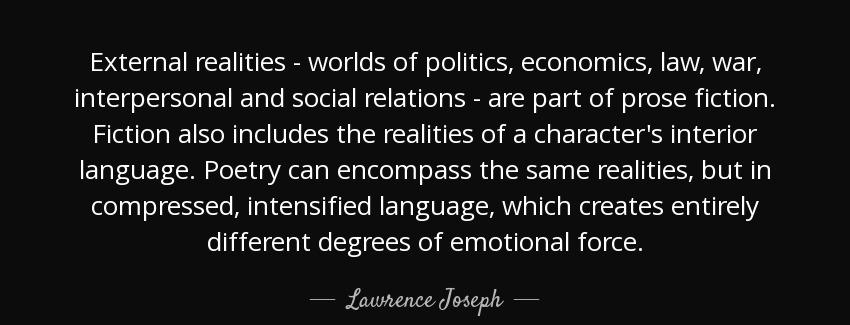
I've always believed that poetry must speak of realities as least as complicated as those spoken of in prose. I've read books of poems, even single poems, which are, for me, at least the equivalent of a short story or a novel. Martin Amis, in an interview with Saul Bellow in the early eighties, quotes Bellow asking, "Why not address 'the mysterious circumstance of being', say what it's like to be alive at this time, on this planet?" This has been and still is my ambition.
source: - Source: www.commonwealmagazine.org
Topics: Book, Ambition, Reality
My sense of the poet is classical - the poet is one who makes poems. In each book, I develop and repeat certain general themes - time, place, memory, God, history, class, race, beauty, love, poetry, identity. The core identity is the poet making the poems.
source: - Source: www.commonwealmagazine.org
Topics: Memories, Book, Identity, Love Poetry
Do I address issues of the spirit, of the soul, in my work? Yes, definitely. As for being a Catholic poet, I was born in, and into, Catholicism - Eastern Rite Maronite and Melkite Catholicism. Not being Catholic has never been a choice for me - it's in my family, my ancestry, going back centuries. Catholicism, for me, is always here.
source: - Source: www.commonwealmagazine.org
Topics: Choices, Catholic, Soul