I understood when I was just a child that without water, everything dies. I didn't understand until much later that no one "owns" water. It might rise on your property, but it just passes through. You can use it, and abuse it, but it is not yours to own. It is part of the global commons, not "property" but part of our life support system.
source: - Marq De Villiers (2001). “Water: The Fate of Our Most Precious Resource”, p.14, Houghton Mifflin Harcourt
Topics: Children, Water, Support, Water Is Life
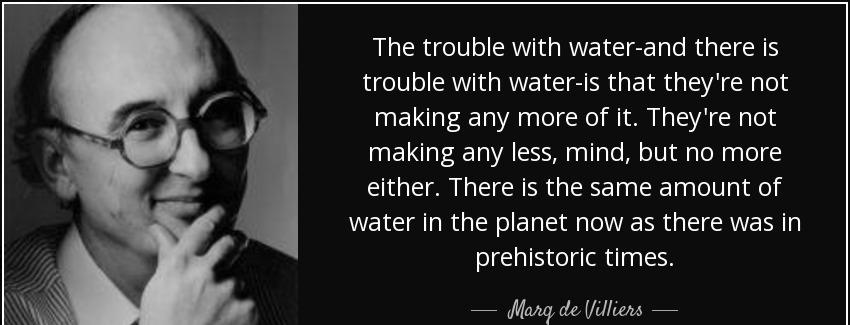
One of the signs of the imminent Apocalypse is the "bitterness of all waters," and anyone traveling through eastern Europe, the former Soviet Union and its satellites-everywhere that the command economy operated, with its callous disregard for anything but narrow-focused abstract principle-could be forgiven for thinking that the Apocalypse was no longer imminent but in full cry. There's hardly a river, stream, or brook that isn't contaminated with the runoff from human misuse, whether industrial effluents, agricultural pesticides and herbicides, or worse.
source: - Marq De Villiers (2001). “Water: The Fate of Our Most Precious Resource”, p.87, Houghton Mifflin Harcourt
Topics: Thinking, Europe, Rivers, Command Economy, Herbicides
All over East Africa-indeed, all over Africa-it is normal for people to walk a kilometer or two or six for water. In more arid areas, people walk even greater distances, and sometimes all they find at the end is a pond slimy with overuse. More than 90 percent of Africans still dig for their water, and waterborne diseases such as typhoid, dysentery, bilharzia, and cholera are common. The bodies of many Africans are a stew of parasites. In some areas the wells are so far below the earth's surface that chains of people are required to pass up the water.
Topics: Distance, Two, People, Typhoid, East Africa